
Have you ever searched for "best dentist near me" or "plumber in my city"? If yes, you have already used an online directory. You may not even know it.
Online directories are everywhere. They help us find people, businesses, and services in seconds. But how do online directories work behind the scenes?
In this article, we will break it down step by step. No hard words. No confusing terms. Just simple, clear answers.
Let's understand this step by step.
Sounds simple? It is. But there is more happening behind that search box than most people realize. Let's dig in.
An online directory is like a digital phone book. It lists businesses, people, or websites in one place.
Think of it like a big library. But instead of books, it stores information about businesses. Things like:
You search for what you need. The directory shows you matching results. Simple, right?
Before the internet, people used printed phone books. Remember the Yellow Pages? Old, thick books full of business listings.
Now, everything moved online. It is faster and easier. That is why online directories exist.
They solve one big problem: helping people find the right business, fast.
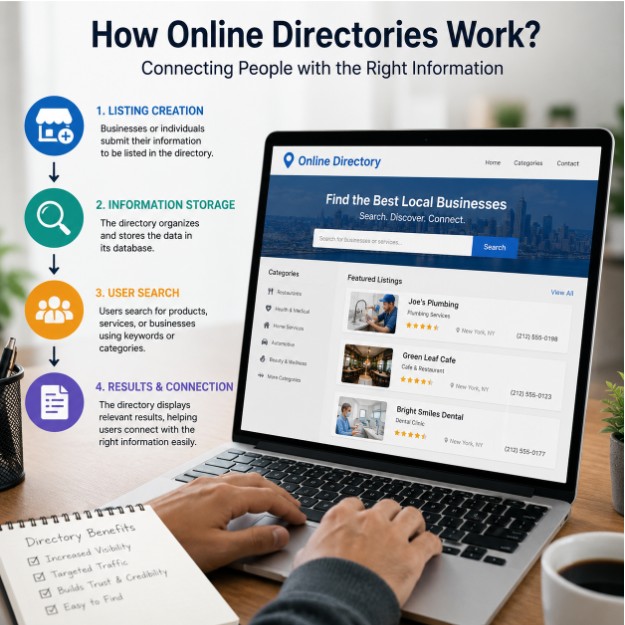
Let's go deeper. Here is exactly how online directories work.
A business owner creates a listing. They add:
This is like filling out a simple form.
Once submitted, the directory sorts this data into categories.
For example, a restaurant goes under "Food & Dining." A doctor goes under "Healthcare." This makes searching easier for users.
Now, a user comes to the directory. They type a keyword like "coffee shop in Lahore."
The directory searches its database. It looks for the closest match.
Within seconds, you see a list. Business names, addresses, ratings, and contact info appear.
You pick the one that looks best. Maybe based on reviews. Maybe based on distance.
You can now:
This is the full cycle. Simple, fast, and helpful.
Not all directories are the same. Let's look at the common types.
These list all kinds of businesses. Examples include Yelp and Yellow Pages online.
These focus on one city or area. Great for finding local shops or services near you.
These focus on one industry. For example, a directory only for lawyers or only for wedding photographers.
These focus heavily on user reviews. Think of TripAdvisor for hotels and restaurants.
Google Maps and Google My Business also work like directories. They show business info, reviews, and location.
These list people, not just businesses. Think of LinkedIn or a doctors' directory on a hospital website. You search by name, skill, or job title.
Cities and governments also run directories. They list schools, hospitals, courts, and public offices. These help citizens find official services quickly.
Each type works the same basic way. Collect information. Sort it. Show it to the right person at the right time.
Let's peek behind the curtain for a minute. Don't worry, this part is still simple.
Every online directory runs on something called a database. Think of it as a giant digital filing cabinet. Every business listing is one file inside that cabinet.
When you search, the directory does not look through paper. It asks the database a question. The database answers in milliseconds.
The directory also has a search system. This system reads your keyword. Then it matches it with listings that fit best.
For example, if you type "bakery in Lahore," the system looks for:
It then ranks the best matches at the top.
Not every business appears in the same order. Directories use ranking rules. These usually include:
This is why keeping your listing updated really matters. A complete profile ranks higher than an empty one.
You may wonder, do we still need directories? Yes, we do. Here is why.
This is a win-win. Users find what they need. Businesses get more customers.
This part is important for business owners.
Search engines like Google trust online directories. Why? Because directories provide accurate business information.
When your business is listed on a good directory, it creates something called a "citation." A citation is simply your business name, address, and phone number listed online.
The more citations you have, the more Google trusts your business. This can improve your ranking in local search results.
That is why smart business owners list their business on multiple directories.
Want to get the best results? Follow these simple tips.
Even experienced business owners make mistakes with online directories. Watch out for these.
Some people think directories are old-fashioned. That is not true.
In fact, local searches are growing every year. People still search "near me" phrases daily. Directories power many of these searches.
Even big platforms like Google Maps work on the same basic idea as traditional directories. They collect business data and match it with user searches.
So yes, online directories are very much alive. They just look different now.
Imagine you just moved to a new city. You need a good electrician.
You open Google and search "electrician near me." Google shows a map with names, ratings, and phone numbers. That map result? It works exactly like a directory.
You pick the highest-rated electrician. You call them. Problem solved in minutes.
This is the real power of online directories. They save time and reduce stress.
Here's another example. A small bakery owner wants more customers. She lists her shop on a local food directory. She adds photos of her cakes and her opening hours.
A week later, a family searching "birthday cake shop near me" finds her listing. They see her strong rating. They call and place an order.
That one listing brought her a new customer she never would have found otherwise. This happens every single day, all over the world.
You might be thinking, isn't this just what Google does? Good question.
Search engines like Google crawl the entire internet. They index millions of websites on every topic.
Online directories are more focused. They only store structured business information, like name, address, and category. This makes their results cleaner and more organized for local searches.
In fact, search engines often pull data from directories to build their own local results. That's why your directory listing directly affects how you appear on Google Maps and search results.
Think of it this way: a search engine is like a huge library with every book ever written. A directory is like a well-organized shelf, sorted neatly by topic. Both are useful, but they work a little differently.
So, how do online directories work? In simple words:
Online directories act like a bridge. They connect people who need something with businesses that offer it.
Whether you are a business owner trying to get noticed, or a user searching for a trusted service, online directories make life easier.
Next time you search "best pizza near me," you will know exactly what is happening behind the screen.
Simple technology. Big impact.
Many directories offer free listings. Some also offer paid plans with extra features, like better placement or more photos.
It depends on the directory. Some show your listing instantly. Others review it first, which can take a few days.
Yes, and you should. Listing on multiple trusted directories helps more people find you. It also helps your SEO.
Yes. In fact, small local businesses often benefit the most. Directories help them compete with bigger brands in local search results.
Look for directories with real user reviews, clear categories, and a clean, easy-to-use website. Avoid directories full of spam listings or fake reviews.