
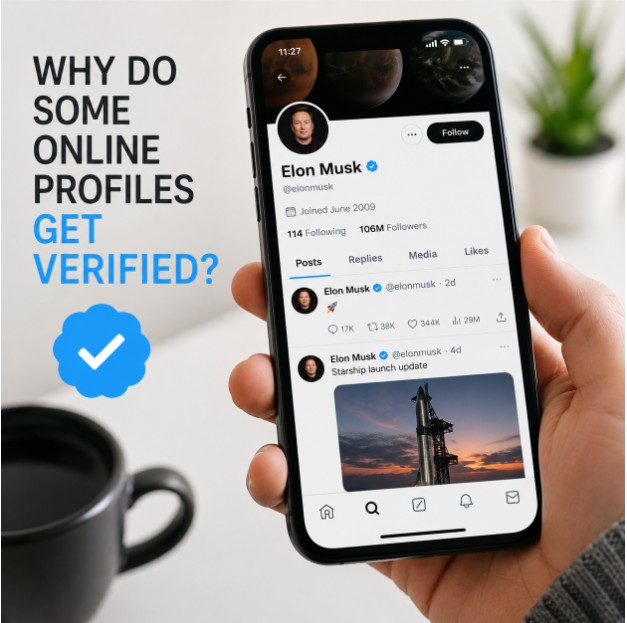
Have you ever seen a little blue tick next to someone's name on social media? You look at it and think, "Why does that person have it? Why don't I have it?"
You are not alone. Millions of people ask this same question every day.
In this article, we will answer the question "why do some online profiles get verified?" in very simple words. No hard English. No confusing terms. Just plain talk, like a friend explaining it to you.
By the end, you will know:
Let's understand this step by step.
A verified profile is an account that a platform (like Instagram, Facebook, X, or LinkedIn) has checked and confirmed as real.
Think of it like this. Imagine a school. A new student joins. The teacher checks his ID card first. Once the teacher is sure the student is really who he says he is, the teacher allows him to sit in class.
Verification works the same way online.
The platform checks:
If the account passes the check, it gets a badge. Usually a blue tick, a grey tick, or a gold tick, depending on the platform.
This is the real question, right? Let's break it into simple reasons.
There are many fake accounts online. Some people copy the name and photo of a famous singer, actor, or business owner. They trick fans into believing it's the real person.
Verification stops this confusion. It tells users, "This is the real one. Trust this account."
Would you trust a random stranger with your money? No, right?
Same thing happens online. When people see a verified badge, they feel safe. They believe the account is honest and real.
This is very important for:
Imagine a fake account pretending to be your favorite cricketer. It asks fans for money or shares wrong information in his name. That would create a big problem, right?
Verification protects famous people from this kind of misuse. It also protects the fans from getting cheated.
Search engines like Google also trust verified accounts more. Why? Because Google wants to show real, safe, and trusted content to its users.
This matches Google's E-E-A-T rule, which means:
Not every random account gets a blue tick. Platforms have some common rules. Let's look at who usually qualifies.
This includes:
These people are famous and searched by many users. So platforms verify them to avoid fake copies.
Big and small businesses also get verified if they show:
News accounts get verified so people know the information is coming from a trusted source, not a random troll account.
Government pages get verified to stop people from spreading fake announcements or wrong information.
Every platform has different rules, but most ask for similar things. Let's keep this simple.
Think of it like applying for a passport. You can't just say, "I am a citizen." You need documents to prove it. Verification works the same way.
Now let's talk about action. What can you actually do?
Add a clear photo. Write a proper bio. Add your website if you have one.
An empty profile looks fake. A full profile looks real.
Post regularly. Don't disappear for months. Active accounts look more trustworthy.
Comments, likes, shares… these all matter. Platforms see if real people are interacting with you.
If a news site, blog, or YouTube channel talks about you, it helps a lot. It proves you are a known person or brand.
Every platform has a request form for verification. Search for it in your account settings and apply with correct details.
Verification takes time. Some people wait weeks. Some wait months. Don't lose hope if you get rejected once. Improve your profile and try again.
Let's talk about common mistakes too, so you can avoid them.
Avoid these mistakes, and your chances go up a lot.
Yes, it really does help.
Verified profiles usually rank better because:
Basically, verification is a trust signal, both for humans and for Google's algorithm.
| Feature | Verified Profile | Unverified Profile |
|---|---|---|
| Trust Level | High | Low or unsure |
| Risk of Fake Copy | Very low | High |
| Search Ranking | Usually better | Usually average |
| User Confidence | Strong | Weak |
| Business Value | High | Limited |
So, why do some online profiles get verified?
Simple answer: platforms want to protect users from fake accounts and build trust. Verification proves that a profile is real, honest, and worth trusting.
If you want to get verified too, focus on being real. Complete your profile. Stay active. Build genuine engagement. Follow the rules.
Trust takes time to build, both online and in real life. But once you build it, it opens many doors.
Keep growing, stay authentic, and your day will come too.
Some platforms offer free verification if you meet the criteria. Others, like certain paid subscription badges, may charge a monthly fee. Always check the platform's official rules.
Yes! Many platforms now allow normal creators, small business owners, and professionals to get verified if they meet the requirements.
Don't worry. Improve your profile, stay active, build more real engagement, and apply again later.
Not directly, but it builds trust. And trust usually brings more followers over time.
No. Every platform has its own color, rules, and process. Instagram, X, and LinkedIn all work a bit differently.